
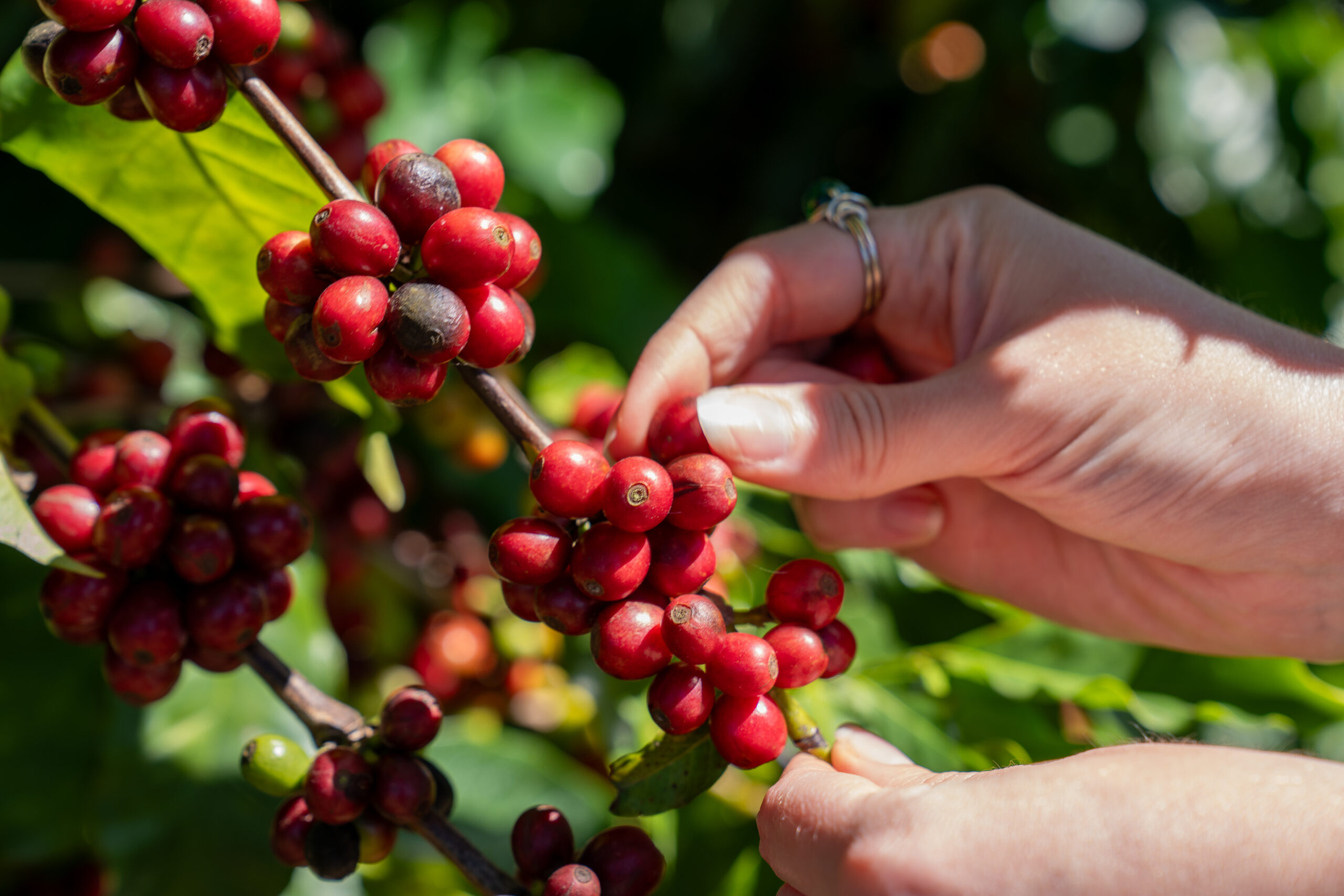
We arrived at Jaques Coffee Plantation expecting to stay for a couple of hours. Instead, we spent the entire day being swept into the family’s world. One conversation became another as we were passed between family members, each eager to share another chapter in the plantation’s history: its humble beginnings, devastating setbacks, hard-won innovations and the occasional rivalry that helped shape Australia’s coffee industry. Every answer sparked another question, another tour, another story.
Between conversations, the unmistakable whirr of the coffee harvester drifted in and out across the plantation, disappearing into the rows of glossy coffee trees before returning again. At one point, our photographer abandoned the interview to chase it down for a photo, while Nat Jaques even coaxed us from the safety of the tour buggy to bury our hands in compost made from recycled coffee skins – a surprisingly memorable lesson in sustainability that lingered beneath our fingernails well into the next day.
It quickly became clear that this wasn’t simply a coffee tour. It was a window into the resilience, innovation and determination required to build a life in Australian agriculture.
“We’ve never really looked back,” Linda Jaques said. “It didn’t matter what was thrown our way, we just thought we were going to overcome this and do it for our family.”
When Linda and Nat established one of Australia’s earliest commercial coffee plantations in the late 1970s, they believed Australia could produce exceptional coffee. What followed was decades of cyclones, failed harvests, soaring interest rates that forced them to lose their original plantation, and a government fruit fly eradication program that destroyed young coffee trees just as they were starting again.
“Many people go, ‘oh, you’re so lucky!’ Maybe we’re lucky, but we’ve also had to work a lot to get to this,” Linda continued. “We’ve been through a lot of hardships and speed bumps, but we’ve been creative and it’s worked well.”
That creativity is woven throughout the plantation today. Visitors follow the journey from tree to cup while discovering how coffee processing waste becomes compost, coffee cherry skins become cascara tea, experimental varieties continue to be trialled, and renewable energy helps power the property. The same willingness to adapt that carried the business through decades of setbacks now shapes every visitor’s experience.
At the centre of it all is Nat. Equal parts inventor, engineer, coffee grower and storyteller, he moves effortlessly between explaining harvesting equipment, discussing business decisions and greeting visitors as though the conversation has never stopped. After decades spent helping shape Australia’s coffee industry, his advice for anyone looking to diversify is refreshingly practical.
“If you don’t get it right the first time, start again and again and again. You always [need] a clear focus on what you want to do, and stick with it,” Nat said. “If you can value add to your product and cut out the middlemen, you’re going to make some money,” he added. “Keep your borrowings to a minimum and work the business on a shoestring for the first few years at least to work out problems before you start involving purchase and borrowings for more capital to reduce the risk.”
The Jaques family’s journey may be uniquely their own, but the impulse behind it is increasingly familiar across regional Australia. As farmers face rising costs, climate variability and changing markets, many are looking beyond traditional production models and finding new opportunities in agritourism, often with promising results.
According to Tourism Research Australia’s Agritourism in Australia 2025 Report, travelers who participated in agritourism experiences spent $20.3 billion in 2024, with the sector continuing to grow in visitor numbers, overnight stays and expenditure. Visitors who engage in agritourism have also been shown to spend more per trip than the average traveler and are more likely to explore regional Australia.
And behind the visitor numbers lies a common thread: for many farming families, agritourism isn’t simply about attracting tourists – it’s about finding new ways to adapt while remaining true to the land and livelihoods they have built over generations.
Hundreds of kilometres west, Lyn French and her family arrived at much the same conclusion. They’ve been running Gilberton Station since the 1800s, transforming what started as a butcher’s shop, a pub, and a parcel of crown land into an award-winning tourist destination. While they endured various hardships throughout that time, it was the millennium drought that threw the ultimate curveball and led Gilberton Outback Retreat to become what it is today.
“Water was scarce, cattle numbers were down and, like many in the Gulf Savannah, we were under real pressure,” Lyn said. “It was a moment where we had to ask ourselves: how do we keep this property, this family and this business not just surviving, but thriving?”
The answer to such a demanding question was tourism. Welcoming visitors onto a working cattle station meant sharing far more than the day-to-day realities of beef production. It meant opening the family’s home, history and connection to Country to people eager to better understand life on the land.
“Turning to tourism was a leap of faith,” Lyn said. “It didn’t just diversify our income; it strengthened the resilience of our family and business. It gave us a way to weather droughts with confidence because we were no longer reliant on one income stream.”
Yet resilience alone isn’t what keeps visitors returning. Lyn emphasised how the success of their business has rested upon something deeper: a genuine connection between people and place.
“Our approach to agritourism is deeply rooted in respect – respect for the land, for its natural cycles and for the people who have cared for it long before us,” Lyn said.
“By blending sustainable land practices with meaningful cultural connection and our stories – real stories from seven generations who walked before us – we aim to create an agritourism experience that’s authentic, respectful and enriching for both our family and our visitors.”
That philosophy shapes everything from land management to the stories shared with guests. It also reflects the broader character of Australian agriculture, where around 99 per cent of farms are family owned and farmers collectively steward more than 51 per cent of the nation’s land mass.
Through their relationships with local Indigenous people and commitment to caring for Country, the French family ensures that visitors gain a richer understanding of the landscape itself, not simply as a place of production, but as a living environment shaped by the culture and history many generations.
“Everyone who comes leaves inspired,” Lyn said. “Sharing our paddock-to-plate journey and showing guests where the cattle graze, how they’re cared for and how that becomes a meal makes the connection to Country tangible and memorable.”
After chatting with Lyn over the phone, and unexpectedly spending an entire day with the Jaques family, we too were inspired. Agriculture is the industry that sustains us more than any other, yet much of its complexity remains hidden from everyday life. Too often, we take it for granted. Stepping behind the scenes offered far more than an insight into where our food and fibre come from; it revealed the resilience, ingenuity and determination required to keep Australian farms persisting no matter the obstacles.
And so, while coffee plantations and cattle stations may look very different, the families behind them have discovered that resilience isn’t built in isolation. Sometimes, it begins by opening the farm gate and inviting others to experience life on the land, one conversation at a time.


