
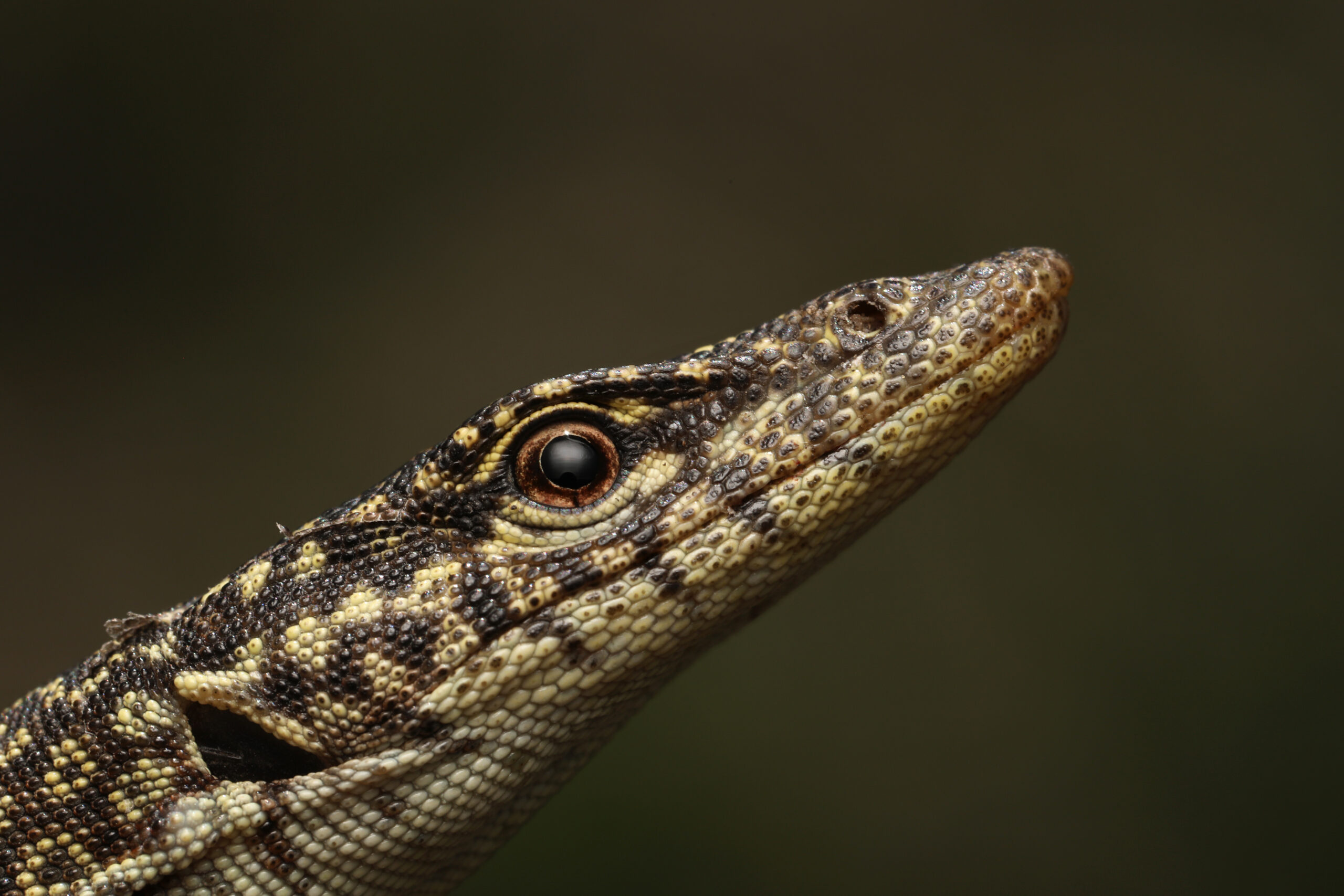
The Gulf’s rugged ranges have revealed another remarkable secret, with scientists formally describing three previously unknown species of rock monitor after years of fieldwork and genetic research.
The newly described lizards – the orange-headed rock monitor (Varanus umbra), the rainbow rock monitor (Varanus iridis) and yellow-headed rock monitor (Varanus phosphoros) – were found across rocky landscapes in North Queensland, challenging long-held assumptions about the region’s reptile diversity.
The research was led by Dr Stephen Zozaya, a postdoctoral herpetologist at the Australian National University (ANU) whose work focuses on the evolution and diversification of Australian reptiles, alongside PhD candidate Wesley Read, whose research explores evolutionary patterns using Australian geckos.
The discovery itself began almost by accident in 2021, when two of the other authors and Mr Read were searching for other reptiles. After stumbling across the first two species “completely by luck,” he and his team returned a year later with eyes peeled specifically for goannas. To their surprise, they not only located both undescribed species again, but were able to add a third to the mix.
“When Wes came in with the photos of what became the orange-headed rock monitor, I was just like: what the hell is that?” Dr Zozaya said.
“Enthusiasts in North Queensland had known about these things for a while, but no one ever really knew whether they were a different species or not.”
While local naturalists and Traditional Owners have recognised these distinctive goannas for years, scientists had assumed they were simply regional forms of the widespread freckled monitor.
It wasn’t until the ANU research team combined detailed genomic analysis with comparisons and examinations of museum specimens that scientists confirmed they represented three entirely separate species.
“We were just blown away when we got the first lot of sequencing back. They were very divergent…obviously a different species,” Dr Zozaya said.
Published in the Zoological Journal of the Linnean Society, the study reveals the three species belong to a previously unrecognised evolutionary lineage that diverged from its closest relatives around seven million years ago.
The findings also represent the first formal description of rock-adapted monitor lizards from North Queensland’s savanna country, highlighting just how much remains to be discovered across the region.
“Over the last few decades, [people] have often fixated on places like the Kimberley or Arnhem Land as these incredible, super diverse areas,” Dr Zozaya said.
“When you get to Northeast Queensland, everyone just remembers the rainforest … but we’re starting to form a picture of the reptile diversity of the eastern savannas.”
The findings add to a growing list of newly described reptiles from the Gulf’s rocky landscapes, including several geckos and skinks identified over recent years, suggesting there are likely more species yet to be formally recognised.
And for Mr Read, that’s a reflection of a broader reality: science is still catching up with biodiversity that has existed all along.
“Western science always lags behind,” he said. “Taxonomy is a slow process as well, and there’s definitely more diversity out there that we haven’t recognised, so ongoing investigation is always a good thing.”
“I would say that goannas haven’t so much as opened the floodgate [into the region’s reptile research], as that they’re part of the flood itself,” Dr Zozaya added.
Despite the hype, the researchers are also mindful that increased attention can bring new challenges, such as susceptibility to the illegal wildlife trade.
While the commercial export of Australian reptiles and amphibians is a criminal offense, a 2022 study found 170 endemic species had been traded as pets overseas, while Australian Border Force intercepted 4,000 illegal shipments last year alone.
Though rock monitors are particularly sought after, and publicity can place additional pressure on accessible populations, Dr Zozaya believes transparency is ultimately more valuable than attempting to conceal their locations out of fear for trafficking.
“I think there’s more to be gained from informing landholders and actually keeping an eye on the known spots, than there is trying to keep them quiet from everyone for a long period of time,” he said.
“They’re tough animals that live in a rugged landscape. The remoteness of where they live will basically do most of the hard work in keeping them protected.”
And for all the excitement surrounding the discoveries, their location might be the biggest surprise of all. Though the remoteness of their habitat may be enough to safeguard against traffickers, it’s remarkably close to home for those dedicated to their conservation.
“These three new species are all within a few hours of the two biggest cities in Northern Australia,” Dr Zozaya said.
“This isn’t some remote corner of the Amazon, or the foothills of the Himalayas. You can just find brand new things within a few hours’ drive and be back home at the end of the day.”
With Australia already recognised as home to the world’s greatest diversity of reptile species, discoveries like these are a reminder that many of the country’s landscapes may still have new stories to tell.
The next remarkable find may be closer than anyone expects.
Photography by Edward Evans.


