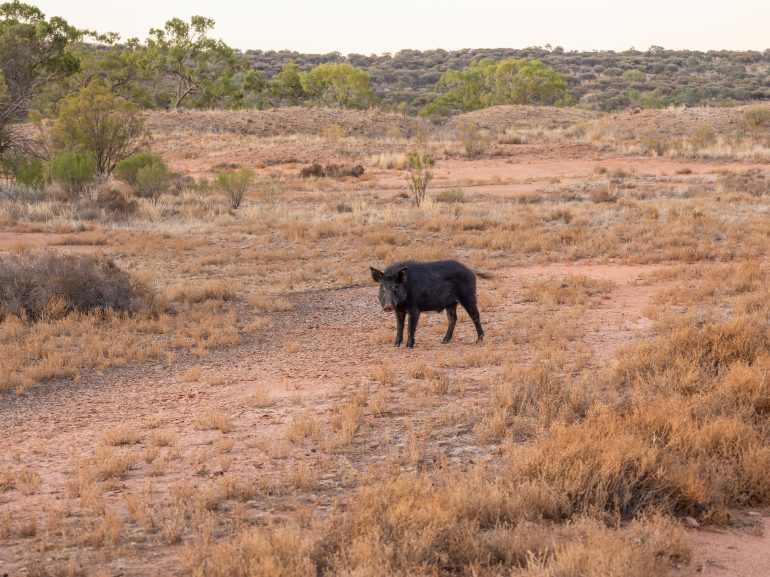
Mareeba, Queensland – Over 400 feral pigs have been removed from Brooklyn Wildlife Sanctuary in Far North Queensland after two years of successful aerial shooting.
Delivered by Gulf Savannah NRM (GSNRM) in partnership with Australian Wildlife Conservancy (AWC), the program reinforces growing evidence that aerial shooting can be significantly more effective than traditional on ground methods and should play a central role in feral pig management across Australia.
GSNRM Biodiversity Officer Dr Edward Evans said aerial control offers major benefits in both efficiency and scope.
“Aerial pig control is often advantageous over ground-based control as you can cover a much larger area and access remote places you are unable to reach on the ground,” Dr Evans said.
“While the costs of running a helicopter are relatively high, the time investment saved compared to say baiting and trapping is huge and often outweighs the financial costs.”
Findings from AWC’s most recent Aerial Pig Control Activities Report verifies these claims, as it highlights the following:
- The operation resulted in a record number of pigs removed, significantly exceeding previous annual efforts, which typically required around 120 labour hours over three weeks to remove approximately 50 pigs.
- With aerial shooting, accessibility issues are minimised, meaning that pig control can be carried effectively for 100% of the year.
- Large lagoons within Brooklyn Wildlife Sanctuary, previously heavily impacted by feral pigs, have shown significant recovery, with improved water clarity and increased native waterlily coverage following the control program.
Key for conservation
Effective feral pig management is crucial for large-scale ecosystem conservation, particularly in priority areas where pigs are causing significant damage to habitats and waterways.
Federal Member for Leichhardt, Matt Smith said wild pigs were one of Australia’s most destructive invasive species, causing over $156 million in agricultural losses annually.
“Up here in the Far North, they present significant risks to our beautiful Tropical region’s biodiversity, competing with over 100 threatened native species,” Mr Smith said.
“The quickest and most humane way to stop a pig is with eyes in the skies and a finger on the trigger. These aerial crews have prime position to take out the invasive threat with proven techniques.
“I commend all the staff at Gulf Savannah NRM, braving treacherous conditions on a daily basis to ensure there are 400 fewer of these dangerous vermin contaminating our wetlands and wildlife. Endangered species like the northern quoll and bettong will sleep safer in their dens and nests tonight knowing that these sounders have been silenced.”
Gulf Savannah NRM’s investment in the program is part of federally funded biodiversity projects aimed at improving critical habitats locally.
Priority sites include Brooklyn Wildlife Sanctuary, Mareeba Tropical Savanna and Wetland Reserve, Kondaparinga Station, and surrounding wet sclerophyll forests in Mount Lewis and Mount Spurgeon National Parks.
Programs like this demonstrate the potential for aerial control to deliver scalable, landscape-level solutions to one of Australia’s most persistent environmental challenges.
The outcomes are contributing to improving the condition of the Eastern forests of Far North Queensland, a priority place identified in the Threatened Species Action Plan 2022-2032.
This project is funded by the Australian Government’s Saving Native Species Program and delivered by Gulf Savannah NRM, a member of the Commonwealth Regional Delivery Partners
panel.