
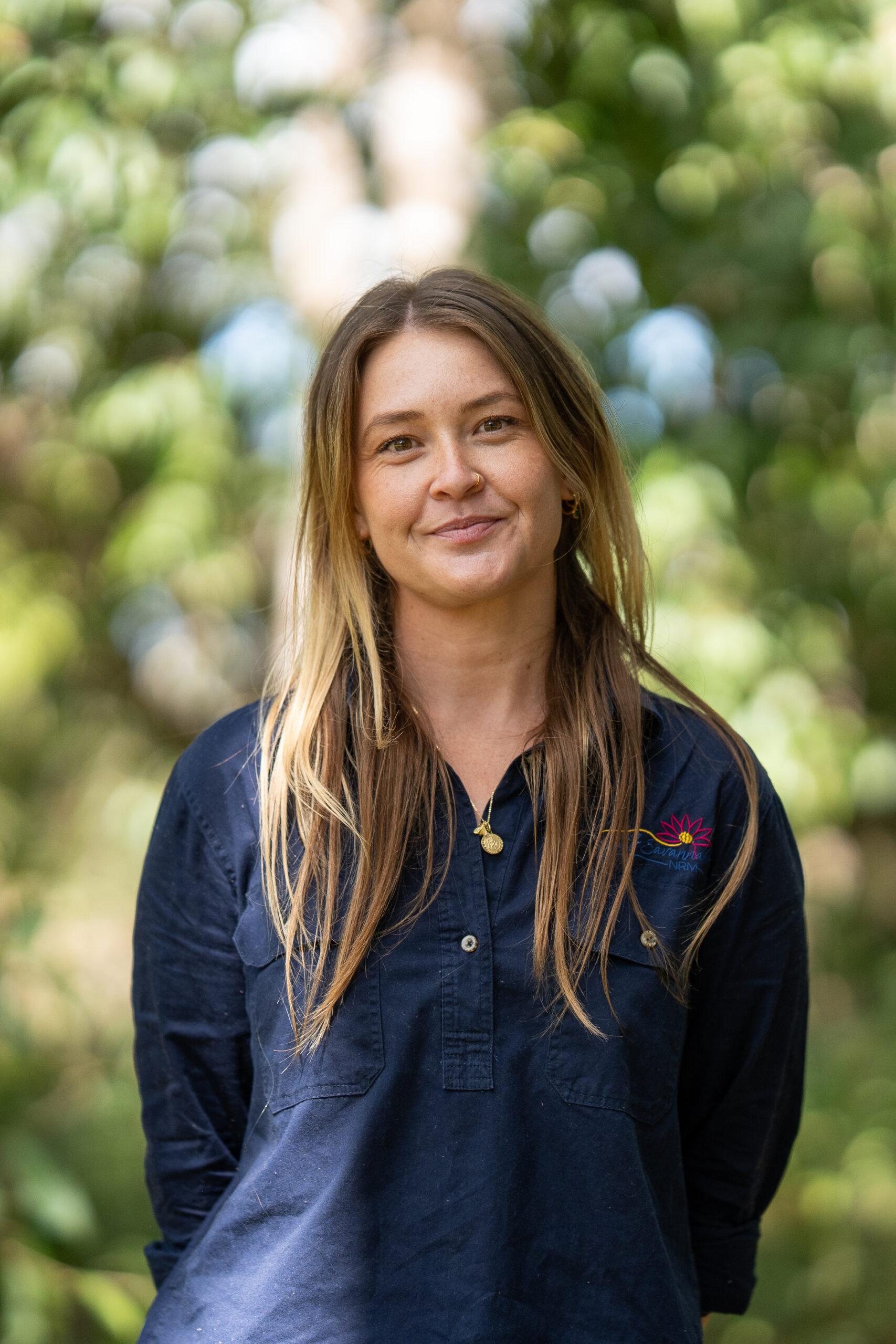
From volunteering in a Tibetan refugee camp in Nepal to working alongside smallholder rice farmers in Cambodia, Lucinda “Indi” Dunn’s path into agriculture has been anything but conventional.
Now the recently appointed Drought and Climate Change Facilitator with Gulf Savannah NRM, Indi is bringing that global perspective to regional Queensland through her work on the Business and Community Drought Resilience Project across the Gulf Hinterland.
Finding impact in unassuming places
Despite building a career in agricultural science and community resilience, Indi admits this field was never originally on her radar, and that throughout her younger years growing up in Brisbane she “didn’t know what agriculture was, to be perfectly honest!”
Indi was always searching for a career that felt meaningful and impactful, but after initially studying education and social work at university, that search led her overseas.
“I’ve always wanted to do something that supports people and provides options for informed decisions, especially for those who might be in a disadvantaged situation,” Indi said.
“I went to Nepal, volunteered for a month and was living in a Tibetan refugee village where I saw some of the agricultural production that went on around there,” she said.
“I was learning about it and hearing stories about crop loss due to poor planting techniques, but those issues weren’t being rectified due to lack of resources and varied information sources.”
That experience became a turning point.
For Indi, agriculture suddenly revealed itself as something far bigger than farming alone, but instead a system deeply connected to food security, livelihoods, environmental health and community wellbeing.
Returning to Australia, Indi enrolled in Agricultural Science at the University of Sydney, where she later completed her Honours research investigating hoverflies as alternative pollinators and biological control agents.
From there, she undertook a PhD focused on insect pest management for Cambodian rice farmers and spent two years working directly alongside these communities.
Now having relocated to the Gulf region, Indi says one of her biggest goals is to help people recognise the enormous role agriculture plays in everyday life, and highlight why the industry deserves far more attention and investment.
“Ag often gets looked over even though we know the importance of it,” she said.
“It’s not just farming … or cattle in a paddock. It’s a whole supply chain and industry, so it’s livelihoods, the economy, health, soil and the environment. It’s one of the most complex systems of all.”
“If you have a poor agricultural system, you’ll have a poor health system and economy in a place like Australia.”
That systems-thinking approach now sits at the centre of her work as Gulf Savannah NRM’s Drought and Climate Change Facilitator.
Clearly defining ‘resilience’ at a local level
Developed in collaboration with local governments, industry representatives, service providers and community members, the Business and Community Drought Resilience Project is currently implementing the Gulf Hinterland Regional Drought Resilience Plan.
Despite the haziness often surrounding what ‘resilience’ actually looks like, Indi is clear in her definition and approach.
“Resilience means the ability to anticipate, absorb, accommodate or recover from the effects of a hazardous event in a timely and efficient manner,” she said.
To achieve this outcome, the project’s current phase is focused on understanding what resources events such as drought realistically require on the ground, and what support people need moving forward.
“We really want to determine the current state of drought and other climate events and talk to people about how they see themselves managing and preparing,” Indi said.
“We can then support communities progress from their current state to desired state and bridge those gaps.”
Importantly, Indi says the project is not looking at drought or climate challenges in isolation.
“Drought, fire, heat, and floods are affecting and will affect everyone more and more as the years go by, and that’s not just in agriculture,” she said.
“These extreme climate events affect our economy, community health and wellbeing, but also our animals and supply chains.”
Community engagement will therefore play a critical role in shaping the next phase of the project, particularly when all stakeholders are given a seat at the table.
“We need to make sure that we focus on some of the more isolated communities and the people who often miss out in rural or regional Queensland.”
To help identify these gaps and priorities, Indi is currently seeking community input through a drought resilience survey. Responses will help inform future project planning, support initiatives and resilience strategies across the region.
To ensure your voice is heard, complete the relevant survey below either as a producer or industry representative.
COMPLETE THE SURVEY
Option 1: Graziers, producers and landholders
Option 2: Industry representatives and service providers
The Regional Drought Resilience Planning program is jointly funded through the Australian Government’s Future Drought Fund and the Queensland Government. Development of the plan has been supported by the Australian Government (Department of Agriculture, Fisheries and Forestry) and the Queensland Government (Department of Primary Industries).