
STORY BY LYDIA STROHFELDT
Plagued by a global fungal disease, anguished by a warming climate, isolated on ‘sky islands’ and disfigured by mysterious tumours, frogs across Queensland, and the globe, are quietly enduring what some call an amphibian apocalypse. A ‘ribbeting’ analysis of frog threats and decline reveals the scale of their struggle.
I have never personally participated in a frog survey, or any wildlife research for that matter. Through the stories of others, however, I’ve come to discover three critical elements for such an expedition: a visceral passion for the natural world, a not-too-nihilistic view on its decline, and a solid pair of hiking boots.
It takes a special kind of stamina to intentionally bear witness to the disappearance of something you’ve gifted a piece of your partiality to, all while usually cold, wet, and itchy. But each week throughout Queensland, someone shoulders these essentials in a rucksack and heads out in search of frogs, both rare and common species alike. Headlamps at the ready, they’re prepared to shine a light on whatever they might, or might not, discover across the everchanging Australian wilderness.
One such person is Dr Ed Meyer – biologist and longtime volunteer with the Queensland Frog Society. Over three decades, he has watched wave after wave of decline, but still speaks about frogs with an unbreakable affection rather than despair.
“When you go out chasing frogs at night and you hear a booming chorus, there’s this celebration of life,” he said.
“Under the cover of darkness, with the frogs singing their hearts out after the rain, it’s just endearing. It’d be a sadder world without them.”
That sadness is not hypothetical. Amphibians are now considered the most threatened vertebrate group on Earth, with more than 40 per cent of species globally at risk of extinction. In Australia, frogs have been the subject of one of the most devastating wildlife disease events ever recorded.
“I always had an interest in native wildlife but took a particular interest in frogs because of the issue which was, at the time, unexplained declines in native frog species throughout largely undisturbed, often pristine rainforest streams,” Dr Meyer said.
“The ecological mystery I’m talking about was largely solved with the discovery of the amphibian chytrid fungus and recognition that it was likely an exotic pathogen that had the capacity to kill frogs.”
As a result of chytrid outbreaks from the 1970s onward, Australia’s frog populations have plummeted dramatically. One assessment of long-term data shows an overall decline of about 97 percent in relative abundance, meaning that for every 100 frogs seen in the mid-1980s, fewer than three are now recorded.
In fact, chytridiomycosis (the disease caused by chytrid fungus) is implicated in the extinction of at least seven native Australian frog species, including remarkable gastric‑brooding frogs (Rheobatrachus vitellinus and R. silus). These extraordinary species, which carried their young in their stomach, are among those not seen for almost 50 years. Though only discovered in 1984, R. silus was last seen in 1985.
Now, new threats emerge.
“The vicissitudes of climate – the variability and the increasing extremes, the droughts and the more intense wet periods, are wreaking havoc,” Dr Meyer said.
“In some parts there are rainfall deficits … and in the absence of rainfall things aren’t able to breed and recruit successfully over a number of years, so some species that are reliant on regular recruitment can disappear altogether,” he said.
“We’re also seeing issues now with the opposite problem, where we’ve got concerns about heavier wet season rainfall in some coastal areas, which is allowing fish to colonise ephemeral wetlands. [This leads to] susceptibility of predation by pest fish.”
Research shows that species reliant on ephemeral wetlands are vulnerable to climate change because their breeding and recruitment require predictable wet seasons and sufficient inundation. When rainfall falters, those populations can fail to produce juveniles for years.
And yet, ecosystemic interaction with climate change is never a ‘one-size-fits-all’ scenario, because ecology is inherently complex. While unpredictable rainfall patterns threaten frog reproduction, a warming planet may also reduce chytrid fungus in certain environments, which typically thrives between 17 and 25 degrees.
But with this ebb comes another flow, especially for mountaintop species.
“Mountaintop frogs face climate risks as rising temperatures alter orographic cloud patterns: the moist air that condenses on mountains and sustains these habitats,” Dr Meyer explains.
“Less cloud interception, or occult precipitation, reduces essential moisture, threatening the cool, damp environments these species rely on.”
As the threats to Queensland’s frogs multiply – from exotic pathogens to shifting rainfall and creeping temperatures – the consequences are perhaps best understood through the eyes of those on the frontlines. Across the state, scientists and conservationists are documenting real stories of decline and resilience.
Stories from the frontlines
At Gulf Savannah NRM, our resident ecologist is rarely found at his desk. He often swaps the piercing fluorescents of the office for the misty slopes of Mt Lewis National Park. Despite the challenges of a Far North Queensland wet season – which typically drapes trees across dicey dirt roads and ushers leeches from sludge into scientists’ socks – Dr Edward Evans carries on with his field work conserving a rare local frog species.
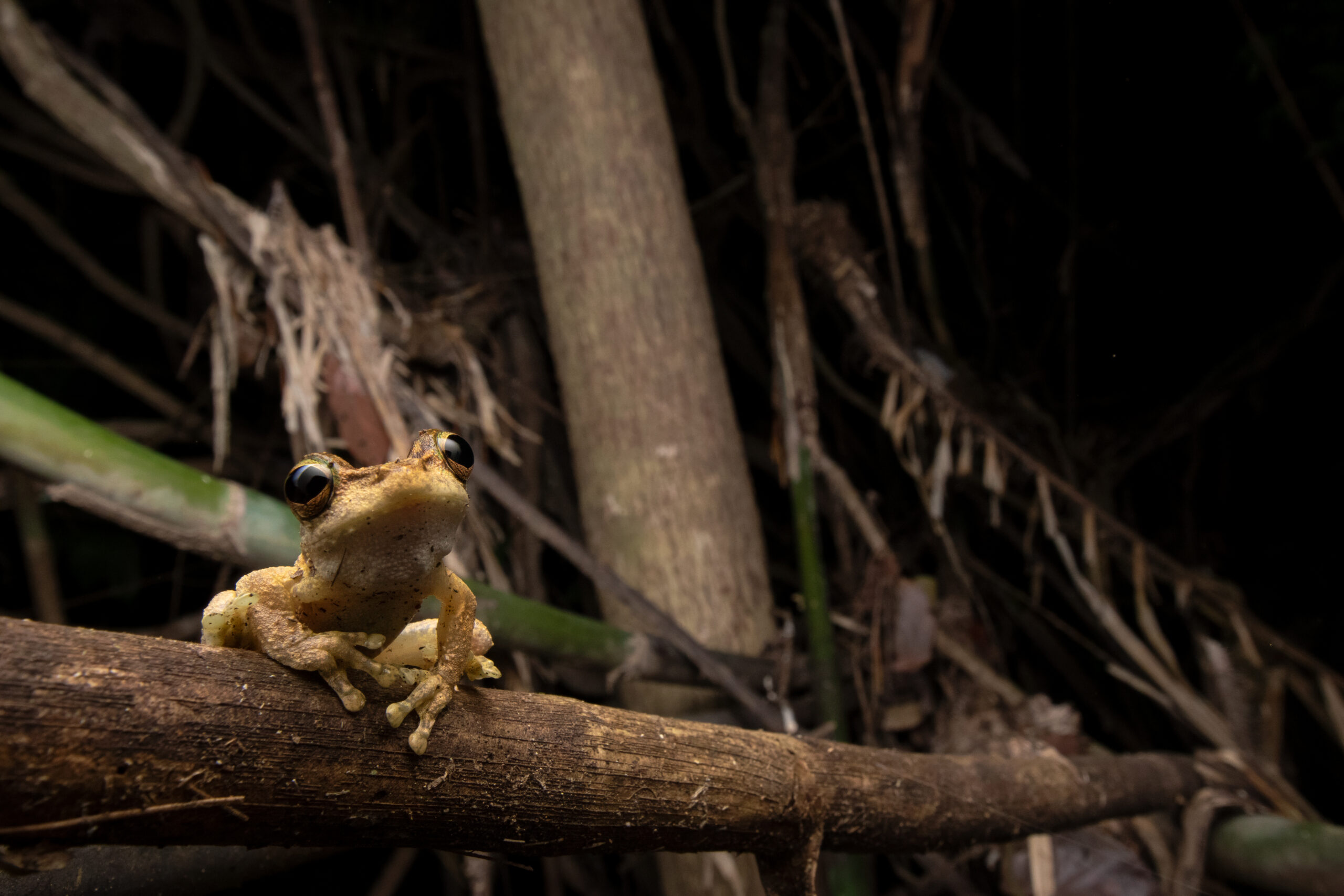
In collaboration with Terrain NRM, Dr Evans has spent the past 12 months working to protect the elusive mountaintop nursery frog (Cophixalus monticola), whose survival depends on cool, damp microclimates that are increasingly at risk of disappearance.
This unique little creature, growing up to 2 cm, is listed as critically endangered. Found only at altitudes of 1100m or above (about twice the height of the Empire State Building) on the upper slopes of Mt Lewis, it is one of the most range-restricted frogs in all of Australia.
Though chytrid has yet to be introduced to its environment, C. monticola is grappling with its own set of challenges.
“High elevation adapted species like this get squeezed up onto what people often call ‘sky islands,’ putting them in this precipitous place where they’re more likely to go extinct due to the effects of climate change,” Dr Evans said.
“Unless these frogs are capable of adapting to changes in climate in a suitable timeframe, their distribution will keep shifting to higher elevations until there’s nowhere left to go.”
Climate models suggest more than half of the nursery frog’s suitable habitat could become environmentally unsuitable as temperatures rise and cloud patterns, like those described by Dr Meyer, are altered.
If the habitat’s small-size and fragility wasn’t enough, this particular frog’s breeding process only compounds its vulnerability. Unlike many amphibians, which typically reproduce in water, this species is part of a family of frogs that give birth on land. A female C. monticola lays her eggs beneath a mix of moss, lichens, and leaf litter – often within Linospadix palms – where the male fertilises and guards them until they hatch, not into tadpoles, but froglets. It’s an unusual, but fascinating lifecycle.
Unfortunately, it also places the frog’s eggs directly in the path of one of the rainforest’s most destructive invaders: feral pigs.
Gulf Savannah NRM and Terrain NRM’s work on Mt Lewis seeks to investigate just how much damage pigs are causing, whether it is scientifically quantifiable, and how necessary feral pig management is for this habitat.
“Anecdotal evidence suggests feral pig activity has increased in high elevation rainforests,” Dr Evans said.
“Though pigs probably aren’t targeting the frogs specifically due to their small size, they’ll be eating lots of other stuff under logs such as earthworms, and in the process turning everything over, disturbing and potentially killing frogs that are hiding there, as well as impacting the Linospadix palms used by the frogs for breeding”
Pig diggings also appear to be changing the hydrology of the area, and in disturbed areas heavy rainfall is more likely to wash away leaf litter vital for sheltering frogs and their egg clutches, as well as possibly increasing exposure to diseases such as chytrid which spreads through water.
“The big question,” Dr Evans continues, “is how much the visual impacts we can see from pigs are contributing to the decline of C. monticola. That’s what our experiment will hopefully help answer.”
Restricted to this fragile sliver of rainforest few people will ever walk through, these frogs are by definition, rare. Having already likely lost seven native species to extinction, while over 20 others teeter on the edge, it makes sense that conservation effort gravitates toward those perched so visibly on the brink. And yet, rarity is not the only measure of risk.
Without consistent historical surveys, it becomes difficult to determine whether familiar species – those woven into suburban ponds and childhood memories – are also slipping. The dependable green tree frog, once considered a staple of any damp Australian backyard, may not be as indestructible as nostalgia suggests.
“It’s all quite anecdotal, and lack of historical monitoring data is an issue for many species, including common ones,” Dr Evans said.
“It can be hard to disentangle emotion from ecology, particularly in conservation work, but if there’s a decline in frog numbers across the board, we should be extremely concerned about common species too.”
It’s a sentiment that transports us from the cloud-wreathed slopes of Mt Lewis to the small treatment room at Frog Safe.
For more than 25 years, Deborah Pergolotti has watched frogs arrive at her Innisfail-based hospital from across the Wet Tropics and Far North Queensland, all the way from Mackay to Cape York. Some come with visible injuries – such as mower strikes, chemical burns and whipper-snipper wounds – while others arrive carrying something less obvious: a swelling suggestion that the landscape itself is changing.
Like Dr Evans and the scientists surveying mountaintops, Ms Pergolotti believes the absence of baseline data is masking a broader decline, not only for rare species, but common frogs too.
“Older generations who remember what was ‘normal’ will notice that what they used to see commonly isn’t there anymore,” she said.
“Tracking a decline on an official level means you need a starting point or a benchmark … but there is no benchmark to start with, so [the government] doesn’t accept that numbers are falling for any of the species still officially considered common.”
In the absence of long-term datasets, her hospital has become an informal archive of environmental distress. Among the thousands of frogs treated since 1998, Ms Pergolotti has observed a gradual but worrying increase in tumours: growths whose origins remain uncertain, but which she suspects may be linked to chemical exposure.
“Paradoxically, chytrid is very rare in the cases we see at our hospital. But if those cases come in, we have our own treatment protocol which makes it much easier to cure than the other problems we see. Something else is attacking the frogs on the far north Queensland
coast,” she said.
“We know the environment is highly contaminated. What little toxicology work has been done in Australian wildlife shows that chemicals banned 20 years ago are still turning up in live animals.”
Funding for toxicology testing is scarce, she adds, leaving many questions unanswered. But the patterns are difficult to ignore. The reality is that frogs, with their permeable skin and complex life cycles spanning water and land, are widely regarded as bioindicators – early warning messengers of ecosystem health. And like any creature, they have innumerable roles to play within their environment.
“Sadly, for the gentle, humble frog, its purpose in life is to be eaten by something else,” she said. “But if frogs aren’t there anymore, those species which depend on them have to find something else to eat, and so the effects cascade up the chain.”
She hesitates before invoking a familiar metaphor.
“While I hate to use an expression that is overused, frogs are the ‘canaries in the coal mine’ – they are an alarm bell screaming loudly that our biosphere is damaged and not healthy. We are yet another animal living in that same unhealthy environment.”
For Ms Pergolotti, and almost anyone working in this conservation space, frogs are more than patients on a stainless-steel examination table; their loss, she believes, is almost as existential as it is biological.
“Speaking more metaphysically, the energy of life exists in all living things, and the loss of a species means we are depleted of their purpose, grace, contribution, and beauty.”
If the science leaves gaps, with incomplete datasets and scarce funding, the call to action is unmistakable. Whether from off the beaten track, or a suburban drain, frogs are croaking for our help.
Fighting frog decline ‘in our backyard’
Plagued by a global fungal disease, anguished by a warming climate, isolated on ‘sky islands’ and disfigured by mysterious tumours – frogs across Queensland, and the globe, are quietly enduring what some call an amphibian apocalypse.
As was made clear earlier, I am not someone who conducts transect surveys or ecological research, nor am I a scientist of any kind. My connection to the frogging world is as innate as any of us could hope for: I’m simply a person inhabiting the same world as the innumerable species around us, and slowly coming to terms with what we stand to lose.
I confess, Dr Evans is right! It is terribly difficult to disentangle emotion from ecology. And so, after speaking with the experts, ‘helpless spectator’ no longer feels like a comfortable position. If frogs are declining not only on remote mountaintops, but perhaps also in our suburban creeks and backyard ponds, then the story does not belong solely to scientists; it belongs to all of us.
For Ashley Keune, President of Queensland Frog Society, initiatives taken by the everyday person are not supplementary to preserving biodiversity, but instead foundational.
“Public involvement isn’t just a bonus for frog conservation,” he said. “It’s actually the backbone of the movement.”
While formal surveys remain important, Mr Keune believes the most powerful monitoring tool may already be in place: people paying attention where they live, and utilising accessible tools like the Frog ID app.
“Citizen science is so vital because you’re in your own backyard where those species are,” he said. “An ecologist might go out and do a one-off survey, but if you’re living there and you see changes happening, you can report them.”
In recent years – shaped by COVID lockdowns, shifting volunteer capacity, and the practical realities of coordinating large field surveys – the Society’s focus has evolved. Rather than concentrating primarily on structured scientific transects, much of its work now centres on education and engagement.
Today, that means workshops on building frog ponds, talks about habitat protection and misidentifying cane toads, stalls at garden expos and council events, and guided night walks that replace clipboards with curiosity. The aim is to reconnect people with what’s already living alongside them and patch up our severed relationship with the natural world.
“Getting that environmental love of people in their backyards is, for us, probably the most important thing now.”
And that awareness of our environment quite literally calls us to listen.
The booming chorus Dr Meyer described – the ethereal, post-rain cacophony conducted by our froggy little friends – is not just something to document, but something to defend. Aside from volunteering or filling gaps in data, perhaps what’s required is simply stepping outside after a downpour, listening carefully, and deciding that the silence, if it ever comes, is not something we are willing to accept. Scientist, or otherwise…
The mountain-top nursery-frog (Cophixalus Monticola) is a priority species in the Australian Government’s Threatened Species Action Plan 2022-2032. This project received grant funding from the Australian Government’s Saving Native Species Program.
Photo: Edward Evans