
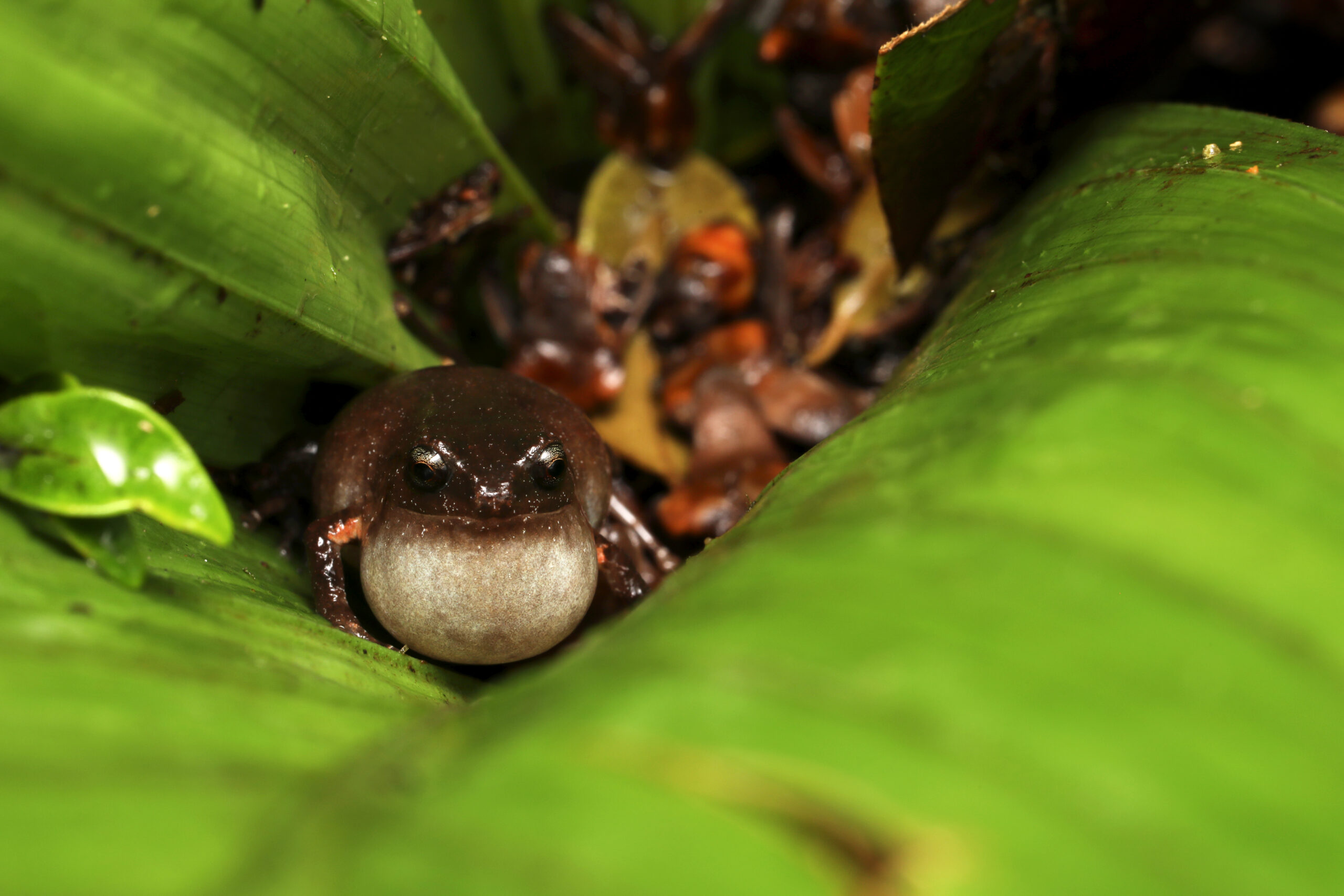
Amid the misty slopes of Mount Lewis National Park, local ecologists are working to protect the critically endangered mountain-top nursery frog (Cophixalus monticola).
In collaboration with Western Yalanji rangers and Terrain NRM, Gulf Savannah NRM Biodiversity Officer Dr Edward Evans has spent the past 12 months undertaking field-based research to better understand the pressures facing the species, whose survival hinges on the persistence of cool, damp rainforest microclimates.
Growing to just two centimetres, this critically endangered frog exists only above 1100 metres on Mt Lewis. Its entire world is confined to a narrow band of high elevation rainforest, making it one of the most range-restricted frogs in Australia.
A species with nowhere left to go
The risks facing the species are closely tied to its elevation and lack of room to move, Dr Evans explains.
“High elevation adapted species like this get squeezed up onto what people often call ‘sky islands,’ putting them in this precipitous place where they’re more likely to go extinct due to the effects of climate change,” Dr Evans said.
“Unless these frogs are capable of adapting to changes in climate in a suitable timeframe, their distribution will keep shifting to higher elevations until there’s nowhere left to go.”
Climate modelling supports this concern, suggesting that more than half of the mountain-top nursery frog’s suitable habitat could become environmentally unsuitable as temperatures increase and cloud patterns change.
The species’ unusual breeding strategy adds another layer of vulnerability.
Unlike many frogs, C. monticola reproduces entirely on land. Eggs are laid beneath leaf litter, moss and lichens – often within Linospadix palms – where they are fertilised and guarded by the male until they hatch directly into froglets.
This reliance on intact forest floor conditions for both sheltering and breeding brings the species into conflict with one of the rainforest’s most disruptive invaders: feral pigs.
Disturbing the forest floor
A key focus of the Mt Lewis project is understanding the extent of pig-related damage and whether it is contributing to population decline.
Dr Evans notes that while pigs are unlikely to intentionally consume the frogs themselves, their foraging behaviour can have significant indirect impacts.
“Anecdotal evidence suggests feral pig activity has increased in high elevation rainforests,” he said.
“Though pigs probably aren’t targeting the frogs specifically due to their small size, they’ll be eating lots of other stuff under logs such as earthworms, and in the process turning everything over, disturbing and potentially killing frogs that are hiding there, as well as impacting the Linospadix palms used by the frogs for breeding.”
Beyond physical disturbance, pig diggings may also be altering local hydrology. In disrupted areas, heavy rainfall can wash away leaf litter essential for shelter and egg survival, while increased water movement may elevate exposure to pathogens such as chytrid fungus.
“The big question,” Dr Evans said, “is how much the visual impacts we can see from pigs are contributing to the decline of C. monticola. That’s what our experiment will hopefully help answer.”
Monitoring and recovery efforts
To build that evidence base, the team has installed ten exclusion fences around clumps of Linospadix palms to investigate the impacts feral pigs are having on the frogs’ habitat, and the frogs themselves. These zones are being used for a whole suite of habitat measurements and will eventually be compared to unfenced sites.
Acoustic recorders have been set up to see if the frogs do better within the protection of the fences, though it will take time before a response in frog numbers is noticeable as the species is “small and presumably doesn’t move too far in a hurry.”
The team has also been using transects – carefully measured survey lines laid out across the habitat – to study pig disturbance in the wider area and build a picture of how pigs are affecting this sensitive environment. This is not just for the sake of the frogs but all other high elevation specialist fauna and flora that share the mountain’s summit.
Western Yalanji Rangers involved in the project say they are seeing the same changes on Country, with pig damage pushing higher into the cloud forest and frog calls becoming increasingly difficult to hear. Fresh pig tracks have also recently been recorded at several known frog breeding sites, underscoring the urgency of the recovery work currently underway.
For Terrain NRM Project Lead Dr Andrew Dennis, the work is as much about restoring ecological balance as it is about ensuring these unique rainforest species have a future.
“I’ve been visiting this region for well over 50 years. Walking in the cloud forest and around the creeks, it used to be noisy with frog calls day and night. Now it’s noticeably a lot quieter,” Dr Dennis said.
“By keeping pigs out of these small patches of habitat, it gives this species a chance to breed and survive. If we consistently record more calling male frogs inside the enclosures, it could pave the way for broader conservation strategies,” he said.
The project’s collaborative approach, combining scientific monitoring with on-ground knowledge from Indigenous rangers, is helping build a clearer picture of what these high-altitude ecosystems need to recover.
In a landscape few people will ever visit, Gulf Savannah and Terrain NRM’s work alongside Western Yalanji is helping piece together the future of a species quite literally living on the edge.
The mountain-top nursery-frog (Cophixalus Monticola) is a priority species in the Australian Government’s Threatened Species Action Plan 2022-2032. This project received grant funding from the Australian Government’s Saving Native Species Program.
PHOTO: Edward Evans