
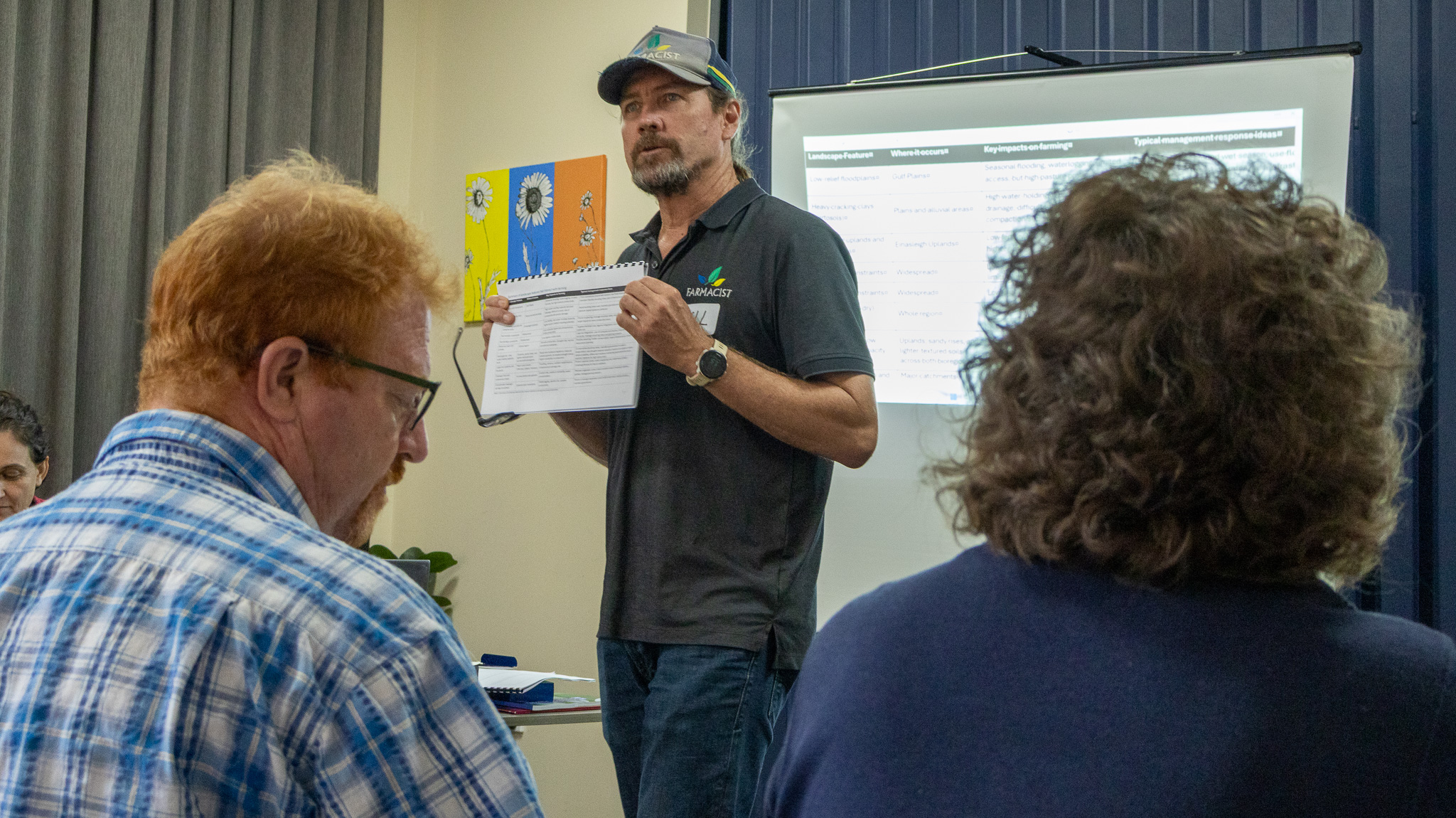
Far North Queensland farmers continue to adapt to climate extremes and landscape variability with the support of Gulf Savannah NRM’s sustainable agriculture initiatives.
On March 30, local producers gathered once again in Mareeba with the goal of unlocking their farms’ full potential amid tough conditions and an even tougher economy.
Bringing structure to agricultural resilience
Farmacist FNQ Program Leader Will Higham led the workshop, sharing his many years of insight as a land resource scientist.
Mr Higham applauded northern producers for their remarkable versatility in responding to seasonal extremities, despite isolation from capital cities and limited support.
“I’ve found farmers up in the north to be so resilient and resourceful”, he said.
“We’re just trying to provide a bit of structure to help support that resourcefulness, innovation, and strength, [so producers can] continue farming in these environments.”
Highlighting the diversity of agriculture and grazing in the Gulf region, Mr Higham said the workshop was designed with a holistic approach, considering climate, landscapes, soils, water resources and social factors.
“The workshop really briefly touches on all these things to develop an action plan of steps you can take in the short, medium and long term to make change and work towards a positive future,” he said.
That structured approach is especially important in northern Australia due to the seasonal volatility producers are responding to.
According to the Bureau of Meteorology, northern regions experience some of the most extreme rainfall variability in the country.
ABARES reports climate variability has a significant impact on farm profitability, with income closely tied to seasonal conditions.
Farmacist Extension Leader Belinda Billing alluded to these pressures and encouraged audience members to build their knowledge of specific land types for long-term success.
“It’s really important to understand the landscape you’re farming within and the different underlying features of that landscape and climate,” Ms Billing said.
“[That way] you can be responsive to the dynamic changes of the economy and climate, but also your own personal family wellbeing and welfare.”
For many attendees, the workshop was an opportunity to consider these influences, while also reflecting on their own practices and learning from others.
Learning from locals
Jennifer Petrich has been grazing cattle on Rifle Creek Station near Mount Molloy for around 25 years. As a trainer and assessor in the agricultural industry, she’s been exposed to various sustainability techniques and continues to search for the next innovation.
For Ms Petrich, the workshop was a focal point for new ideas, especially in response to the wet season’s exacerbation of invasive weeds and feral animals.
“The other stakeholders here have quite diverse backgrounds and businesses. It’s very interesting to hear and listen to how it fits for myself,” Ms Petrich said.
“I have my own local knowledge, but it’s great to have a broader understanding of what’s out there.”
Over at Barron River, aquaculture producer Rodney Ingersoll said the event strengthened connections across the region’s diverse agricultural sectors.
“I thought this workshop would be a great idea to learn some new skills so that I can impact other people as well, and to give back to the community,” he said.
“It’s a fantastic opportunity for different farmers to come together and network. Every farmer in this room is from various kinds of agriculture and aquaculture, so everyone’s doing everything, from limes to redclaw crayfish!”
While the workshop delivered practical insights at the property level, its broader goal was to strengthen the long-term sustainability of agriculture across the region.
Mr Higham said supporting farmers to build resilience is critical not just for individuals, but for society as a whole.
“The reason farming resilience is important for everybody is because agriculture is the basis of our civilization,” he said.
“Without food and fibre, without sustainable farmers having the ability to make an income and produce crops and animals that are valued by the community as a commodity, then we just wouldn’t have the society that we enjoy.”
The workshop was the fifth in a series delivered through Gulf Savannah NRM’s Climate-Smart Agriculture project, equipping producers with the tools and confidence to navigate an increasingly uncertain future.
The Climate-Smart Agriculture Project is supported by the Australian Government through funding from the Natural Heritage Trust under the Climate-Smart Agriculture Program.
For more information, contact GSNRM Agriculture Officer Jessica Miranda: jessica.miranda@gulfsavannahnrm.org