
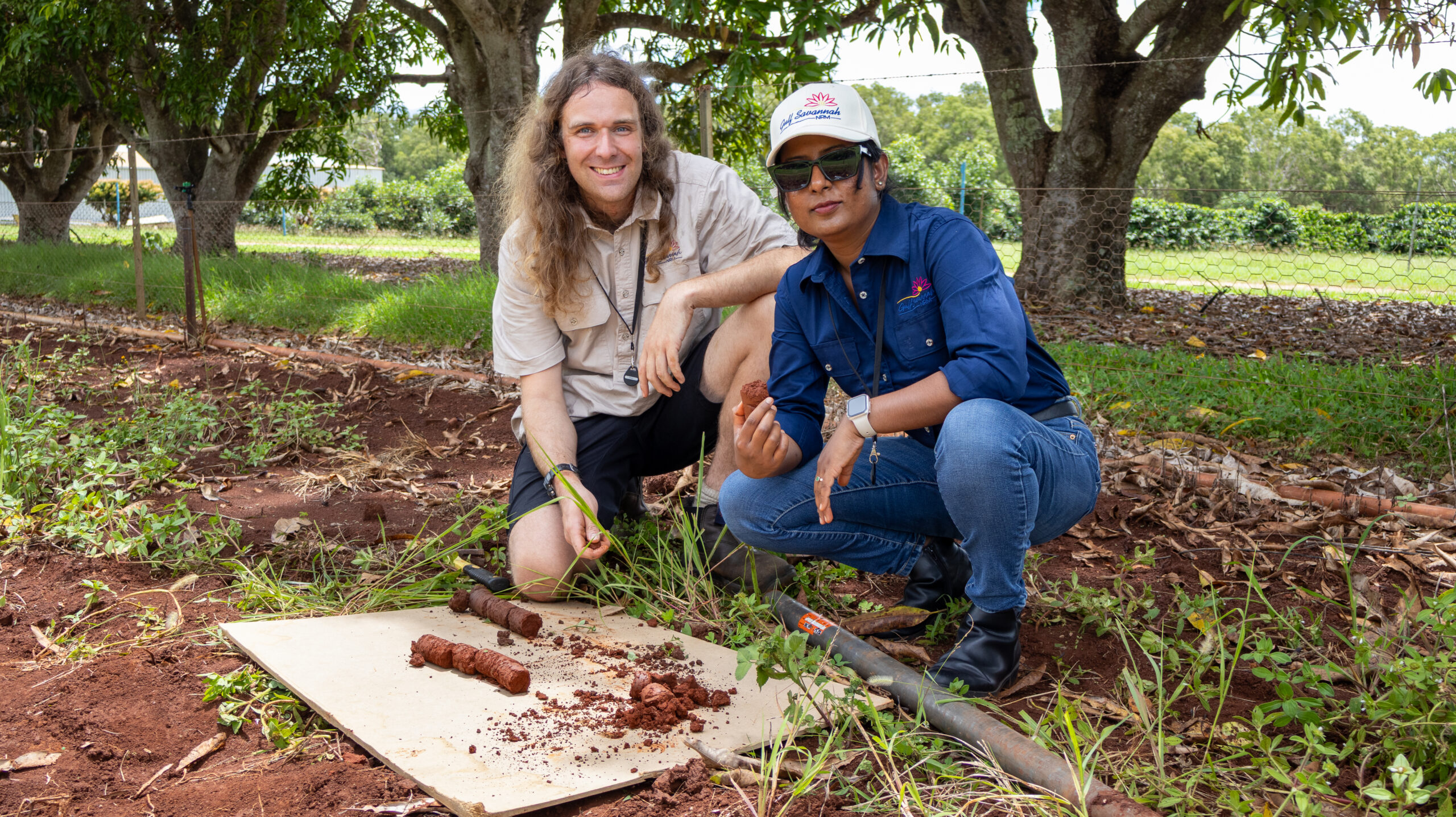
A new collaborative project focused on soil health and climate-smart farming is coming to our region.
Fruit growers across the Atherton Tablelands and Mareeba Shires in Far North Queensland will soon have the opportunity to work together and strengthen the resilience of their orchards.
In partnership with Soils for Life, Gulf Savannah NRM is delivering a three-year Orchard Resilience Project for growers throughout our region. The initiative will bring together local orchardists to share knowledge, learn from each other’s experiences and trial practical ideas on-farm.
Agriculture Project Officer Janani Gedara said the project aims to support orchardists who are managing a range of challenges common to fruit production across the Tablelands.
“Fruit growers in Far North Queensland operate under very unique conditions,” Janani said.
“Producers regularly deal with intense wet seasons and flooding, waterlogging, and pest pressures due to limited spray windows. Rising fertiliser and input costs are also a concern as producers work carefully to maintain consistently productive orchards,” she said.
CSIRO and the Bureau of Meteorology support Janani’s concerns, with research showing Northern Australia has experienced increased rainfall variability and more intense extreme rainfall events in recent decades.
At the same time, ABARES confirms that fertiliser prices in Australia rose significantly between 2021 and 2023.
Against this backdrop, Janani believes empowering growers to adapt on the ground is critical.
“Through this project, we want to support growers to better understand their orchard systems and identify practical ways to improve soil health, productivity and resilience over a long-term period,” she said.
A key part of the project will be the establishment of a demonstration orchard, hosted by JB Citrus in Dimbulah.
Testing at the demonstration site will generate valuable data and insights for growers. Information collected at the orchard will include soil and plant analyses, key soil health indicators, and observations of management practices.
Together, this will support more informed decision-making and a better understanding of how different approaches to irrigation, nutrition and soil management influence orchard performance and resilience over time.
“Having a local demonstration orchard is incredibly valuable,” Janani said.
“It allows growers to see practices in action in FNQ conditions and discuss what might work on their own farms.”
As part of the project, producers will also participate in ten structured sessions to engage in practical discussions and explore new ideas collectively. With specialist support from regional agronomists and industry experts, this peer-learning program will encourage growers to seek advice specific to their farms and better interpret the data collected throughout the soil sampling stage.
“Peer learning is one of the most effective ways farmers learn,” Janani said.
“Growers often gain the most confidence when they can see what others are doing and discuss challenges openly with people facing similar conditions.”
Local producers representing a diverse range of commodities – from citrus, mango, avocado and lychee to passionfruit, custard apple and stone fruit, have joined the network and will participate in the peer learning group.
“By combining grower experience with specialist advice and real farm data,” Janani said, “we hope this program will help orchardists make more informed decisions and build stronger, more resilient farming systems for the future.”
Growers interested in learning more about the project or future activities are encouraged to contact Gulf Savannah NRM.
The Orchard Resilience Project is funded by the Australian Government through the Natural Heritage Trust and delivered by Soils for Life in partnership with regional organisations including Gulf Savannah NRM.