
STORY BY LYDIA STROHFELDT
Inside the world of Australia’s feral pigs.
Before sunrise in northern Australia, the damage is often already done.
Freshly rooted paddocks resemble ploughed earth, wetlands are churned into mud, and fences lie flattened where heavy bodies have pushed through overnight in search of food. By the time landholders arrive, the offenders are gone – moved across property lines, soiling waterways and shredding bushland in their path.
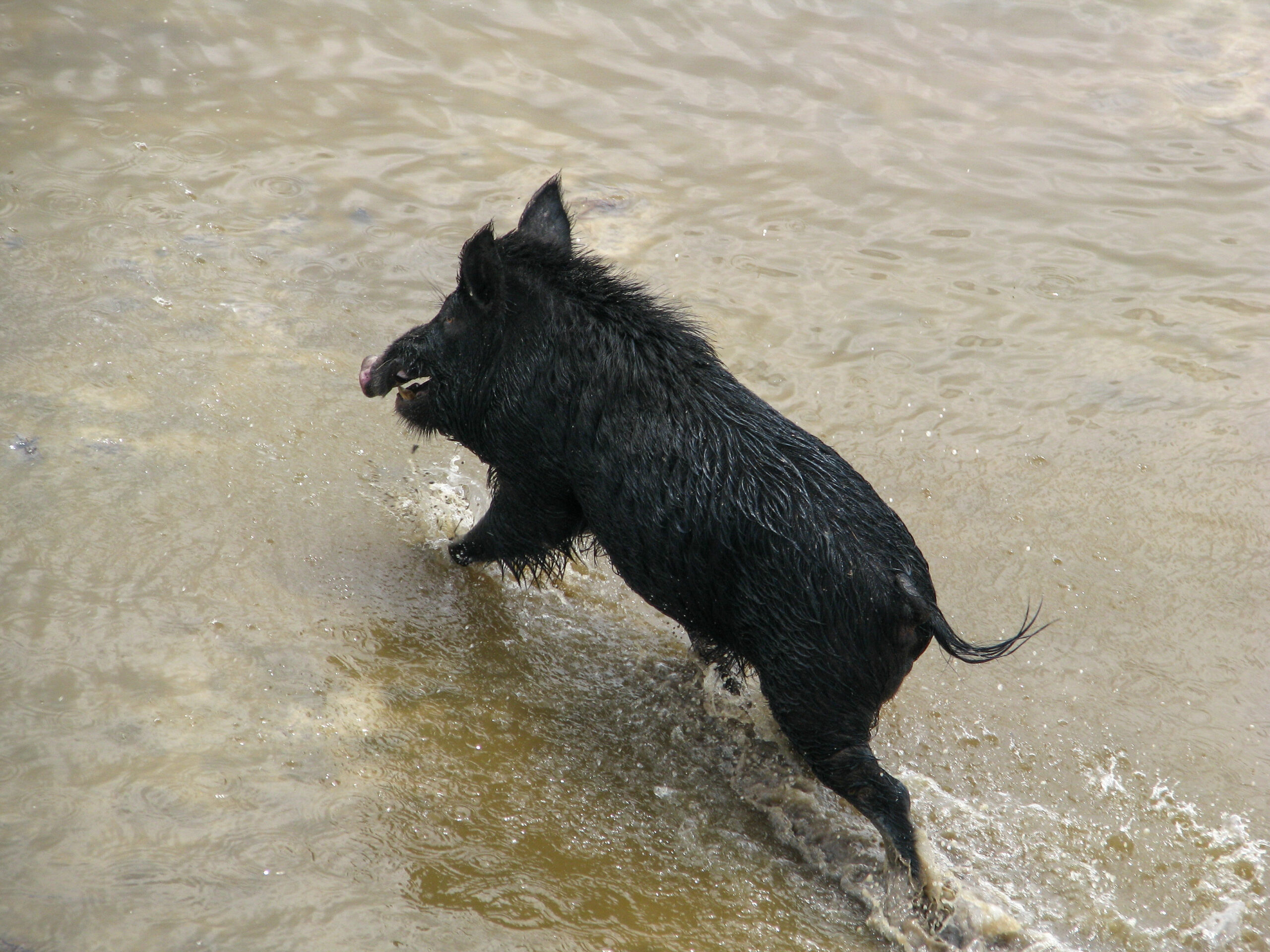
For once, the culprits are obvious: feral pigs.
Now occupying roughly 45 per cent of Australia, populations have grown to an estimate of more than 3.2 million animals. Highly adaptable and notoriously intelligent, they are widely regarded as one of the country’s most destructive invasive pests.
Though crop devastation and native species decline are frequently publicised impacts, damage to cultural legacy remains a quieter and less visible consequence of pig disturbance. For those working in feral pig management, protecting this heritage is central to understanding why control efforts matter.
More than a pest: widespread impacts
Dr Heather Channon, National Feral Pig Management Coordinator, oversees control efforts across the country. Much of her work is shaped by evolving data and population projections, but her greatest concern lies with losses that cannot easily be measured.
“The reason we do this work is because of the damage feral pigs do to our native animals, plants, landscapes, agriculture, and of course, to culturally significant sites,” Dr Channon said.
“Feral pigs can rub rock art off walls. In Victoria, there’s a 6,000-year-old aquaculture system we’re concerned they could root up and destroy.”
She points to Budj Bim Cultural Landscape, where Gunditj Mirring Traditional Owners Aboriginal Corporation have been undertaking intensive trapping and ground shooting campaigns to prevent pigs from damaging any culturally significant sites.
Alongside landscapes and historic places, wildlife of equal cultural significance is also in peril.
“From a biodiversity perspective, pigs are recognised as a threatening process to more than 100 native species,” said former Gulf Savannah NRM (GSNRM) Biosecurity Officer, Scott Morrison.
Studies support this claim. Within our region alone, as many as six species are thought to be in decline due to pig presence.
Pigs achieve this level of destruction through several mechanisms. While foraging, they tear through habitats, digging up soil and vegetation to consume plants from root to fruit. More concerning still is their opportunistic predation: they feed on a wide range of animals, including small mammals, birds, reptiles, frogs, crayfish and invertebrates. Mr Morrison notes that, on multiple occasions, pigs have even been observed devouring calves during birth.
Beyond the visible damage, feral pigs also pose hidden threats. Research shows they can harbour and transmit more than 30 pathogens of concern – including exotic, endemic and zoonotic diseases – as well as dozens of parasite species. These are capable of harming ecological communities, livestock, and even human health.
Gulf Savannah NRM staff have seen the ecological destruction these pests cause on the ground. Across project activities, pigs emerge less as an isolated issue and more as a recurring pattern.
Indigenous Engagement Officer Natarsha Bell says pigs are potentially contributing to the reduction of snake-necked turtles (Chelodina rugosa) in Tagalaka National Park, directly through predation of turtles and nests, and indirectly by reducing habitat quality and resource availability.
Similarly, Biodiversity Officer Dr Edward Evans identifies pigs as a possible contributing factor in the decline of the mountaintop nursery frog (Cophixalus monticola) on Mt Lewis, where severe uprooting has disturbed critical habitat in recent years.
While it can be difficult to measure the specific impacts of pigs within dynamic natural ecosystems, evidence collected across the board leaves little doubt feral pigs represent a significant ecological pressure
And for agriculture, the impacts are easier to quantify.
“North Queensland makes a huge contribution to productivity – from beef and cattle to grains and horticulture, this region is critical for agricultural production,” Mr Morrison said.
“We also, however, have the highest feral pig density in Australia. Because pigs will eat anything and are extremely destructive, many growers experience massive losses each year.”
Those losses are already evident across the country, particularly in Queensland. National estimates from ABARES suggest feral pigs contribute to around $156 million annually in control expenses and production losses due to crop damage, livestock predation and degraded pasture.
Closer to home, a 2020 report by Synergies Economic Consulting found feral pigs cost crop farmers in the Whitsunday region $4 million annually, with reduced productivity and infrastructure damage accounting for the greatest share.
While the full impact has not yet been formally quantified in our region, Northern Queensland’s exceptionally high feral pig densities suggest economic losses could be substantial.
From ancient cultural landscapes to modern agricultural systems, the damage caused by feral pigs reveals a problem measured not only in dollars or data, but in what stands to be permanently lost.
Why are pigs such formidable pests?
Feral pigs are notoriously resilient pests: a reputation earned through a combination of insatiable appetite, intelligence and extraordinary reproductive capacity.
In one example shared by Dr Channon, different groups of pigs in the United States developed specialised feeding habits passed down through generations.
“Some groups ate crabs and others ate turtle eggs, but they didn’t swap,” she said. “The ones eating crabs didn’t eat turtle eggs, and vice versa, so they’ve learned from their mothers.”
Such capability for learned behaviour also allows pigs to adapt rapidly to human activity. They can shift from daytime to nocturnal activity when pressured and learn to hide, avoid traps or outsmart control programs if methods are applied inconsistently.
“If you’re trapping a group of pigs and only catch some of them, the others learn quickly,” Dr Channon said.
“The younger pigs might rush in, but the older ones hang back and watch. Before long you’ve created trap-shy pigs that are much harder to remove. It’s the same with baiting – if they get sick but survive, they remember and won’t touch it again. They’re very smart.”
Biology also works strongly in their favour. Female pigs can breed year-round, producing multiple large litters, while young animals reach maturity in just six months. This allows populations to rebound almost as quickly as they are reduced.
Combined with this rapid growth, their feeding habits make them remarkably adaptable. As opportunistic omnivores that require around 15 per cent crude protein in their diet, pigs follow food, not fences.
“A pig doesn’t care whose property it’s on,” Mr Morrison said. “If there’s food on the other side, it’s going.”
With no boundary capable of holding them, pig removal from one property often just shifts the problem elsewhere. This challenge demands a thoroughly coordinated, landscape-scale approach to see tangible results on the ground.
Solutions: how can people power outsmart the pig?
While this destruction is confronting, Dr Channon says the solution lies less with the animal itself and more in how we manage it.
“Though we’re focusing on the pig, it’s really about how people work in collaboration: coordination, communication and commitment are critical to make the difference that’s needed in reducing their impact,” she said.
“I understand it’s very easy for me to say when I’m not the one on the ground being constantly afflicted by feral pig damage and wearing the cost they impose on landholders, but it’s really important that people make a long-term commitment to a control program after they’ve started.”
With the scale of the challenge clear, attention turns to the practical question facing landholders and managers alike: how do you outsmart a pest as intelligent and mobile as the feral pig?
At the local level, Mareeba Shire Council Land Protection Unit Coordinator Graham Wienert has seen coordinated programs deliver stronger results than isolated efforts.
“One control method doesn’t suit all areas,” Mr Weinert said. “Sometimes trapping is needed, sometimes baiting is needed, and sometimes shooting is needed. We try to cater to the needs of different areas.”
Mr Wienert highlights how regional collaboration between councils, NRM organisations and landholders allows resources, knowledge and costs to be shared, while field days and community engagement help raise awareness of the broader impacts.
“We’re all out there making the public aware of feral pig issues in the region and what it costs everyone through environmental and crop damage,” he said. “We’ve decided to get in together, get the job done, and hopefully get a good outcome.”
And demonstration sites across Australia are beginning to show what coordinated action can achieve.
“Pigs hear a chopper and know what it means, so they go and hide,” Dr Channon said. “That’s where thermal imaging has made a real difference. On Kangaroo Island, after the 2019–20 bushfires, thermal cameras on aircraft allowed operators to locate pigs even through thick undergrowth, helping reduce populations from thousands to around 1,000.”
Inspired by this case study, three Recognised Biosecurity Groups in WA – Central Wheatbelt Biosecurity Association (CWBA), Midlands Biosecurity Group (MBG) and Northern Biosecurity Group (NBG) – are trialing a different approach: they divided the region into zones and spent more time in each, aerially culling every pig encountered rather than targeting presumed hotspots.
The result? Across regions covered by the CWBA and MBG, 4,372 feral pigs have been removed by aerial culling over 207.5 hours of flying time. From January to June 2025, a combined effort of NBG ground and aerial culling removed 11,500 feral pigs across the region. These data do not include feral pigs removed by landholder control efforts.
Still, experts emphasise that technology alone is not a silver bullet.
Improving data collection also needs to be a priority, as despite widespread and clearly observable impacts, consistent national information on damage remains fragmented.
“We don’t really have strong performance metrics yet,” Dr Channon said.
“We’re working with states, territories, and local landholders to develop practical ways to track feral pig impacts, but different enterprises – from cattle to cane to horticulture – experience pigs differently. Some may not realise they have much of a problem, while others are being heavily impacted,” she said.
“Success comes from groups agreeing on what to measure, having a local coordinator to keep momentum going, and following a plan that tracks improvements over time.”
Outsmarting one of Australia’s most adaptable pests, it seems, may depend less on defeating the pig itself, and more on matching its persistence with equally determined collaboration.
“Making sure there’s a long-term view, working together, and using all the available tools in the most strategic ways – those are the three key messages I’d like people to take away,” Dr Channon said.
Though pigs may roam clever and untamed, with minds aligned, humans can match them at their own game.
Regional Feral Pig Coordination Program, funded by DPI through the Queensland Feral Pest Initiative and delivered in partnership with Desert Channels NRM, Cape York NRM, Terrain NRM, Southern Gulf NRM, NQ Dry Tropics NRM and Gulf Savannah NRM.