
Experts highlight regenerative practices to help farmers adapt to climate extremes and support global food security
—————-
As climate change accelerates and global food demand rises, soil health is emerging as a vital consideration for farmers and communities alike.
At a Gulf Savannah NRM (GSNRM) workshop in Mareeba on October 30, experts stressed that nourishing the land beneath our feet is essential to develop local solutions for these worldwide pressures.
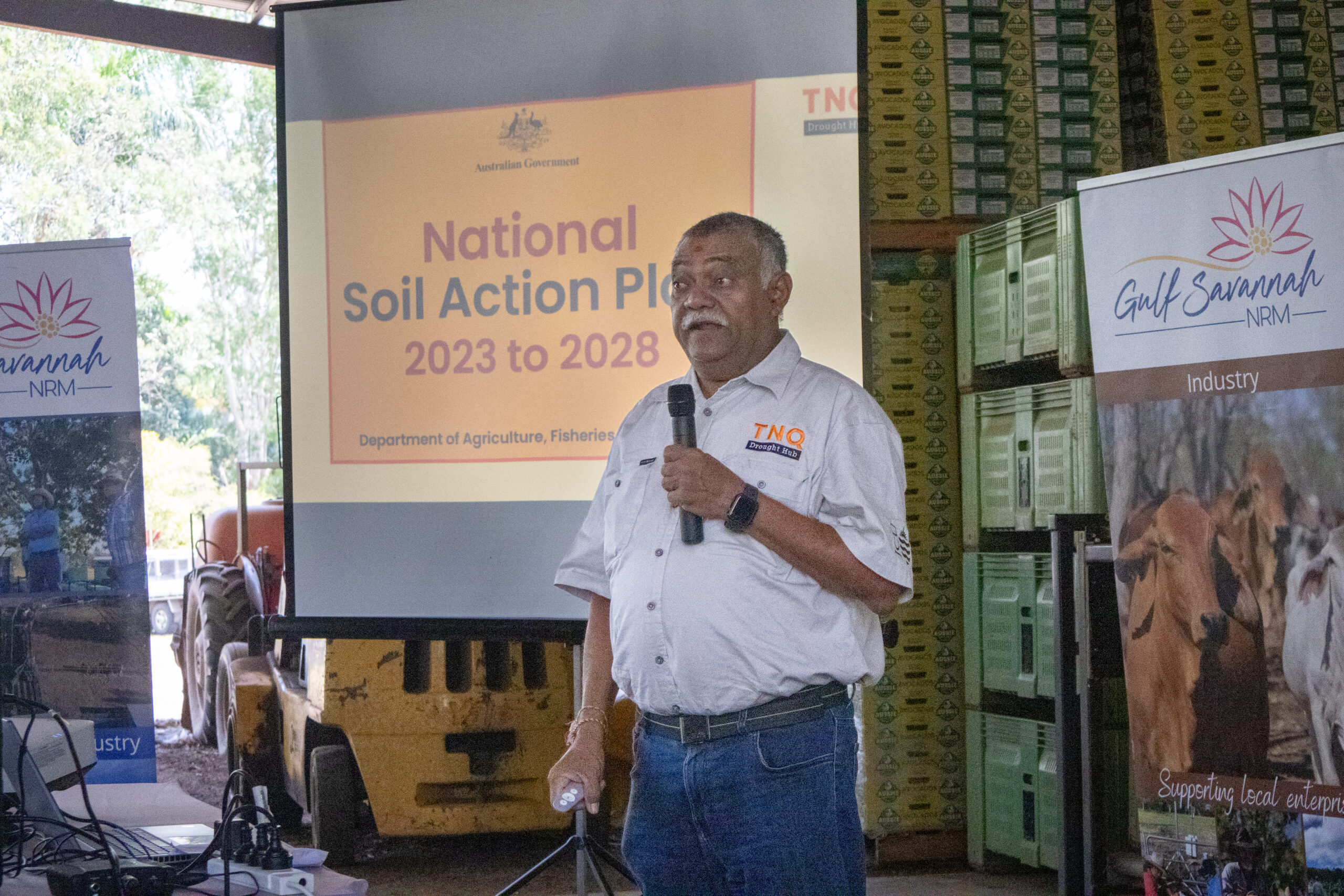
TNQ Drought Hub Regional Soil Coordinator Dhiraj Gajera presented at the event, taking the opportunity to discuss the far-reaching implications of soil health.
“Nationally and internationally, we are facing two challenges: number one is climate change, followed by food security,” Mr Gajera said.
“Soil health isn’t just an issue for government, for growers, or for land managers and owners; it’s an issue for all of us,” he said.
“Because we need food, soil needs to be at the centre: healthy soil produces healthy food.”
Mr Gajera’s work aligns closely with the National Soil Action Plan 2023–28, Australia’s first five-year roadmap to protect and improve soil health as part of the broader 20 year Strategy. Endorsed by the federal government and all state and territory jurisdictions in late 2023, the plan strengthens national efforts to safeguard soil as a critical natural resource.
The plan aims to improve how soil is monitored, strengthen policies that recognise soil’s environmental and economic value, accelerate the adoption of sustainable land management practices, and build the workforce needed to protect soil into the future.
“All NRMs and governments are putting a lot of effort into promoting sustainable agriculture and climate-smart farming, in place with growers,” Mr Gajera said.
“They’re doing their best to minimise the emission of carbon, nitrous oxide and methane.”
Soil as a promising solution
Despite the growing severity of global environmental issues, soil has historroically been under-recognised for its potential.
At GSNRM’s October workshop, Regeneration International President Dr André Lieu demonstrated how its resilient qualities can help farmers create “drought-proof farms.”
“By building up soil organic matter, we can adapt to the increase in climate extremes and climate variability that we’re having in farming,” Dr Lieu said.
“The difference between covered soil and bare soil can be around 24 degrees Celsius — that’s a massive increase in moisture being drawn out,” he said.
“Soil organic matter can capture the rainfall that we get and store it, then it’s there when we go into drought.”
Research suggests each 1 per cent increase in soil organic matter can add tens of thousands of litres of water storage per hectare in the top soil, acting as a reserve for plants between rain events.
This is because organic matter improves soil porosity and structure, which increases both infiltration and retention, keeping water available longer for crops.
Cover crops, mulch, and regenerative practices offer the most effective way to build organic matter and buffer farms against climate extremes by also reducing evaporation and runoff.
But as both Mr Gajera and Dr Lieu emphasise, resilience isn’t just about coping with the weather — the additional challenge is safeguarding food security and improving produce quality.
“At the moment, farmers and consumers are separated by thousands of kilometres … kids think milk comes out of a plastic bottle,” Dr Lieu said.
“We’ve lost our relationship with food, [but are working] to bring back that culture again, and good meals actually start with good produce.”
For local producers, the stakes of soil health are therefore personal and long‑term.
Workshop attendee and director of Tea Extracts Australia Tony Poyner framed it starkly: “If we deplete [our soil], we ruin it, and it’s extremely expensive to regenerate, if it’s even possible,” he said.
“We get one shot at this — we should be grabbing it with both hands and learning [regenerative] techniques that are more cost effective, better for the soil, better for the environment, and better for our own health.”
Attended by over 42 participants, GSNRM’s soil health workshop was the fourth in an ongoing series being delivered to local farmers in our region over a three-year period.
—————–
The Climate-Smart Agriculture Project is supported by the Australian Government through funding from the Natural Heritage Trust under the Climate-Smart Agriculture Program.
For more information, contact GSNRM Agriculture Officer Jessica Miranda: jessicamiranda@gulfsavannahnrm.org